

Unless you’ve lived in poverty, it’s nearly impossible to understand the day-to-day challenges that come with it.
And while a simulation inside Nebraska Wesleyan University’s Knight Fieldhouse can’t replicate what happens in real life, it still gives NWU students a stark look at the issues many families in poverty face every day.
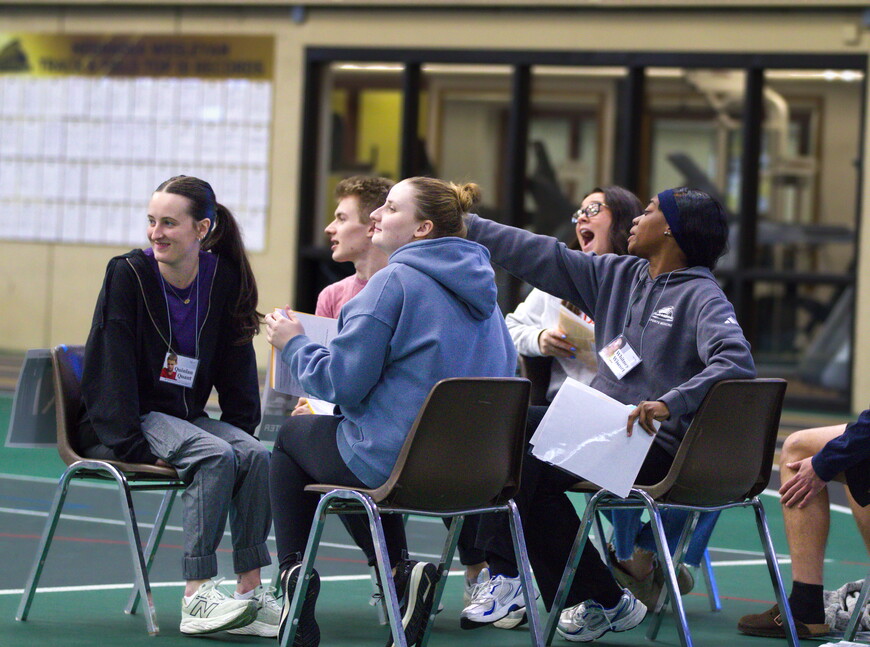
Nebraska Wesleyan’s second poverty simulation, brought together students from multiple disciplines. The collaborative event between the nursing and health and human performance departments also included students in public health, social work, and in the Master’s in Athletic Training program. Senior-level nursing students were able to count the exercise toward their clinical hours.
And while there were moments of laughter and smiles sprinkled throughout the more than two-hour exercise, the scenarios students faced brought real frustrations as groups of students simulated a month living in poverty.
“The students typically find that it’s a very challenging and frustrating experience,” said assistant professor of nursing Jennifer Eilts, one of the simulation’s organizers. “They don’t generally come away with many positive takeaways, just because it’s very difficult for them to manage one month in poverty, and experience what it’s like to not have transportation to get anywhere, and be evicted from their homes, and experience some of those real scenarios.”
Participating students were divided into “families” seated in the middle of the exercise, with each group taking on different circumstances — newly unemployed, single-parent household, homeless, and other scenarios.
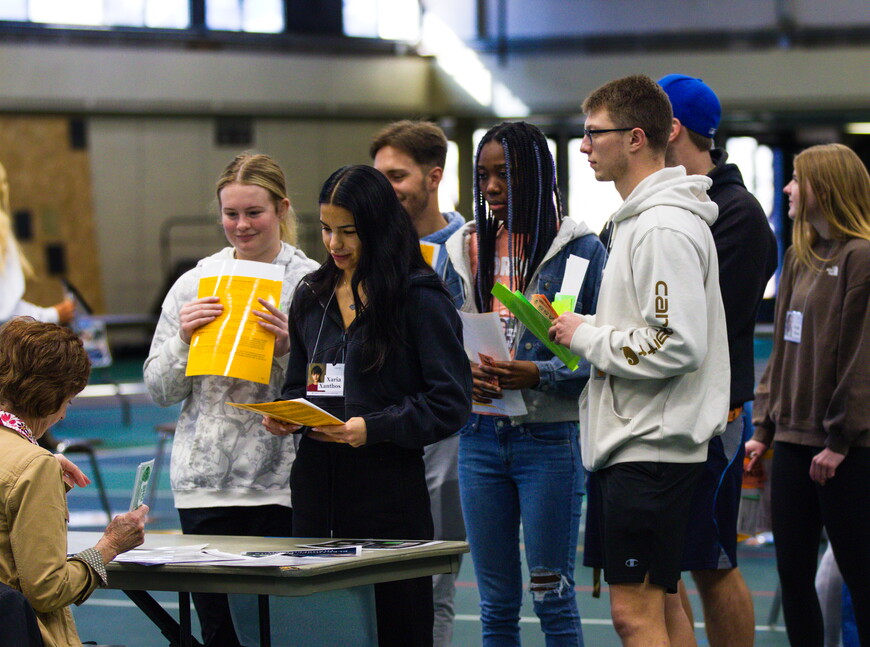
Tables around the perimeter represented community resources and services the families might rely on, including an employer, grocery store, utility company, pawn broker, and a bank, among others.
There was also a jail, which saw its share of occupants during the exercise, as some of the participants played the role of criminals who stole money and other valuables from families.
Those tables were staffed by community volunteers to add another level of realism. The “month” consisted of four 15-minute “weeks” that required participants to go to work, get their kids to school or child care, and pay the mortgage and bills, while navigating unexpected obstacles.
“Our agencies are there to simulate real life, said Kristi McGuire, assistant professor of nursing and another one of the simulation’s organizers. “So if they want to shut down at any moment, they shut down. If (the pawn shop) doesn’t want to give you what your things are worth, or if they want to short you money, it’s supposed to be frustrating. We want students to understand what happens in the system.
“The whole goal of this is to be able to say, ‘I know what resources we have here in Lincoln, this is what we need to do. This is what I can do to help you.’ But until you’ve lived it, it’s hard to understand it on that level. So this is just a very small way for us to get them to understand that.”