Sex Harassment and Sexual Misconduct Prevention and Response (Title IX)
On this page:
Nebraska Wesleyan University (“University”) is committed to establishing and maintaining a community that is free from all forms of discrimination and illegal harassment. The University seeks to create an environment in which the greatest academic potential of students and professional potential of employees may be realized. In order to create and maintain such an environment, the University recognizes that all who work and learn at the University are responsible for ensuring that the community is free from all forms of discrimination and illegal harassment based on sex, gender, gender identity, or sexual orientation, including sexual assault, stalking, sexual exploitation, dating violence, and domestic violence. These behaviors threaten our learning, living, and work environments and are considered prohibited conduct for all University Students and Employees.
Who to call if you are in immediate danger
Call 911
Campus Security, (402) 432-9238
On-Call Residential Education Coordinator, (402) 601-2114
- What is Title IX?
Title IX of the Education Amendments Act of 1972 is a federal law that states: "No person in the United States shall, on the basis of sex, be excluded from participation in, be denied the benefits of, or be subjected to discrimination under any education program or activity receiving Federal financial assistance."
- What behavior is a violation under NWU's Title IX policy?
The 2020 Final Rule for Federal Title IX Regulations provide a clear distinction of prohibited conduct that falls within Title IX jurisdiction.
*Please Note: As permitted by the 2020 Federal Title IX Regulations, the University recognizes additional forms of sexual harassment and sexual misconduct that fall outside the scope of the 2020 Federal Title IX Regulations in a separate University policy. Refer to the NWU Sexual Harassment and Sexual Misconduct Policy Outside the 2020 Federal Title IX Regulations (or refer to the "What behavior is a violation under NWU's Outside of Title IX policy?") to reference additional definitions of sexual harassment and sexual misconduct recognized by the University as Prohibited Conduct.
Prohibited conduct will be addressed when it involves:
- Current students as the complainant or the respondent.
- Current employees as the complainant or the respondent.
And when any one or more of the following criteria regarding scope/jurisdiction are met:
- The conduct occurs on University grounds or other property owned or controlled by the University;
- The conduct occurs in the context of University employment or an education program or University-sponsored activity within the United States, including, but not limited to, school trips, research, on-line classes or meetings, or internship programs;
- The University has substantial control over both the respondent and the context in which the sexual harassment or sexual misconduct occurs; or
- The conduct occurs on property owned or in buildings controlled by any officially-recognized student organization.
And when the report/complaint involves the following prohibited conduct:
Sexual Harassment:
- Quid pro quo harassment by any University Employee;
- Any unwelcome conduct that a reasonable person would find so severe, pervasive, and objectively offensive that it effectively denies a person equal employment or educational access; and
Any instance of sexual assault (as defined in the Clery Act), dating violence/domestic violence, or stalking (as defined in the Violence Against Women Act (VAWA)).
Clery Act Definitions of Violence Against Women Act Crimes
Sexual assault, as defined in 20 U.S.C. § 1092(f)(6)(A)(v), means an offense classified as a forcible or nonforcible sex offense under the uniform crime reporting system of the Federal Bureau of Investigation:
- Sex Offenses, Forcible—Any sexual act directed against another person, without the consent of the victim including instances where the victim is incapable of giving consent.
- Rape—(Except Statutory Rape) The carnal knowledge of a person, without the consent of the victim, including instances where the victim is incapable of giving consent because of his/her age or because of his/her temporary or permanent mental or physical incapacity.
- Sodomy—Oral or anal sexual intercourse with another person, without the consent of the victim, including instances where the victim is incapable of giving consent because of his/her age or because of his/her temporary or permanent mental or physical incapacity
- Sexual Assault With An Object—To use an object or instrument to unlawfully penetrate, however slightly, the genital or anal opening of the body of another person, without the consent of the victim, including instances where the victim is incapable of giving consent because of his/her age or because of his/her temporary or permanent mental or physical incapacity
- Fondling—The touching of the private body parts of another person for the purpose of sexual gratification, without the consent of the victim, including instances where the victim is incapable of giving consent because of his/her age or because of his/her temporary or permanent mental or physical incapacity
- Sex Offenses, Non-forcible—(Except Prostitution Offenses) Unlawful, non-forcible sexual intercourse.
- Incest—Non-Forcible sexual intercourse between persons who are related to each other within the degrees wherein marriage is prohibited by law
- Statutory Rape—Non-Forcible sexual intercourse with a person who is under the statutory age of consent
Dating violence, as defined in 34 U.S.C. § 12291(a)(10), which means violence committed by a person—
- who is or has been in a social relationship of a romantic or intimate nature with the victim; and
- where the existence of such a relationship shall be determined based on a consideration of the following factors:
- The length of the relationship.
- The type of relationship.
- The frequency of interaction between the persons involved in the relationship.
Domestic violence, as defined in 34 U.S.C. § 12291(a)(8), which includes felony or misdemeanor crimes of violence committed by a current or former spouse or intimate partner of the victim, by a person with whom the victim shares a child in common, by a person who is cohabitating with or has cohabitated with the victim as a spouse or intimate partner, by a person similarly situated to a spouse of the victim under the domestic or family violence laws of the jurisdiction in which the crime of violence occurred, by any other person against an adult or youth victim who is protected from that person’s acts under the domestic or family violence laws of the jurisdiction in which the crime of violence occurred.
A Crime of Violence is an offense that has an element of the use, attempted use, or threatened use of physical force against the person or property of another, or any other offense that is a felony and that, by its nature, involves a substantial risk that physical force against the person or property of another may be used in the course of committing the offense.
Stalking, as defined in 34 U.S.C. § 12291(a)(30), which means engaging in a course of conduct directed at a specific person that would cause a reasonable person to—
- Fear for his or her safety or the safety of others; or
- Suffer substantial emotional distress.
Intentional Falsification: Intentional falsification, distortion, or misrepresentation of information as part of the Sexual Harassment and Sexual Misconduct resolution process is a violation of University policy. Any person who abuses the University conduct processes in this way may face disciplinary charges for that violation.
Sexual exploitation is sexual harassment that violates the sexual privacy of another, or takes sexual advantage of another without consent, constitutes unwelcome conduct that a reasonable person would find severe, pervasive, and objectively offensive.
Examples of sexual exploitation include, but are not limited to:
- Voyeurism – watching or taking pictures, videos, or audio recordings of another person in a state of undress or of another person engaging in a sexual act without the consent of all parties;
- Creating, disseminating, streaming, or posting pictures or video of another in a state of undress or of a sexual nature without the person’s consent;
- Exposing one’s genitals to another person without consent;
- Trafficking of another individual;
- Knowingly exposing another individual to a sexually transmitted infection without the other individual’s knowledge and consent; or
- Inducing incapacitation or attempted incapacitation for the purpose of making another person vulnerable to non-consensual sexual activity.
- Intentional sharing of information about the sexual privacy of another person without their consent, either verbally, electronically, or through written material/photos, excluding reports to designated reporting officials for the purpose of harm.
Retaliation: Any act or attempt to seek retribution from any individual or group of individuals involved in the report, investigation, and/or resolution of a sexual harassment or sexual misconduct allegation. Retaliation can take many forms, including, but not limited to, continued abuse or violence, threats, exclusion, and intimidation. Any individual or group of individuals can engage in retaliation. Acts of Retaliation will be addressed under University policies and related procedures.
- What behavior is a violation of NWU's Outside of Title IX Policy?
Some forms of sexual harassment and sexual misconduct must be addressed under Federal Title IX Regulations (See 'What behavior is a violation of NWU's Title IX Policy'). The University is committed to maintaining a community free from all forms of discrimination and illegal harassment. As a result, sexual harassment and sexual misconduct that fall outside of Title IX may be addressed within the outside of Title IX policy and corresponding procedures:
Prohibited conduct will be addressed when it involves:
- Current or former Students as the complainant or the respondent; and/or
- Current Employees as the complainant or the respondent;
And when any one or more of the following criteria regarding scope/jurisdiction are met:
- The conduct occurs off University grounds or on property not owned or controlled by the University; or
- The conduct occurs outside of the context of University employment or an education program or University-sponsored activity and has an adverse effect for students and/or employees; or
- The conduct occurs outside of the United States.
And when the report/complaint involves the following prohibited conduct:
Sexual Harassment:
- Quid pro quo harassment;
- Any unwelcome conduct that a reasonable person would find so severe, pervasive, and objectively offensive that it effectively denies a person equal employment or educational access; and
Any instance of sexual assault (as defined in the Clery Act), dating violence/domestic violence, or stalking (as defined in the Violence Against Women Act (VAWA)).
Clery Act Definitions of Violence Against Women Act Crimes
Sexual Assault: Any sexual act directed against another person, without consent of the victim, including instances where the victim is incapable of giving consent.
The University further defines a sexual act to include intentional contact with the intimate parts of another, causing another person to touch one’s intimate parts, disrobing, or exposure of intimate parts without consent. Intimate parts may include the breasts, genitals, buttocks, groin, mouth, or any other part of the body that is touched in a sexual manner. Sexual contact also includes vaginal or anal penetration, however slight, with a body part (e.g., penis, tongue, finger, hand, etc.) or object, or oral penetration involving mouth-to-genital contact.
Dating Violence is defined as violence committed by a person who is or has been in a social relationship of a romantic or intimate nature with the harmed party. The existence of such a relationship shall be determined based on the reporting party’s statement and with consideration of the length of the relationship, the type of relationship, and the frequency of interaction between the persons involved in the relationship.
For the purposes of this definition:
Dating violence includes, but is not limited to, sexual or physical abuse or the threat of such abuse.
Dating violence does not include acts covered under the definition of domestic violence.
Domestic Violence is defined as a felony or misdemeanor crime of violence committed:
By a current or former spouse or intimate partner of the harmed party;
By a person with whom the harmed party shares a child in common;
By a person who is cohabitating with, or has cohabitated with, the harmed party as a spouse or intimate partner;
By a person similarly situated to a spouse of the harmed party under the domestic or family violence laws of the jurisdiction in which the crime of violence occurred;
By any other person against an adult or youth harmed party, who is protected from that person’s acts under the domestic or family violence laws of the jurisdiction in which the crime of violence occurred.
A Crime of Violence is an offense that has an element of the use, attempted use, or threatened use of physical force against the person or property of another, or any other offense that is a felony and that, by its nature, involves a substantial risk that physical force against the person or property of another may be used in the course of committing the offense.
Sexual Harassment may also take the form of threats, assault, property damage, or violence or threat of violence to one's self, one's sexual or romantic partner, one’s family members or friends, or to the family members or friends of the sexual/romantic partner. The University further includes Emotional Violence and Emotional Abuse as elements of Sexual Harassment within Dating Violence and Domestic Violence.
Emotional Violence can be described as any act including confinement, isolation, verbal assault, humiliation, intimidation, infantilization, insults, threatens, degrades, controls, or any other treatment which may diminish the sense of identity, dignity, and self-worth.
Emotional Abuse, also known as mental or psychological abuse, encompasses many different tactics such as verbal abuse, playing mind games, attacking one’s character, threatening acts of violence in person, in writing, or electronically, against a person who is, or has been involved in, a sexual, dating, domestic, or other intimate relationship with that person.
Stalking is defined as engaging in a course of conduct directed at a specific person that would cause a reasonable person to:
Fear for the person’s safety or the safety of others; or
Suffer substantial emotional distress
Intentional Falsification: Intentional falsification, distortion, or misrepresentation of information as part of the Sexual Harassment and Sexual Misconduct resolution process is a violation of University policy. Any person who abuses the University conduct processes in this way may face disciplinary charges for that violation.
Sexual exploitation is sexual harassment that violates the sexual privacy of another, or takes sexual advantage of another without consent, constitutes unwelcome conduct that a reasonable person would find severe, pervasive, and objectively offensive.
Examples of sexual exploitation include, but are not limited to:
Voyeurism – watching or taking pictures, videos, or audio recordings of another person in a state of undress or of another person engaging in a sexual act without the consent of all parties;
Creating, disseminating, streaming, or posting pictures or video of another in a state of undress or of a sexual nature without the person’s consent;
Exposing one’s genitals to another person without consent through electronic means;
Trafficking of another individual;
Knowingly exposing another individual to a sexually transmitted infection without the other individual’s knowledge and consent;
Inducing incapacitation or attempted incapacitation for the purpose of making another person vulnerable to non-consensual sexual activity; or
Intentional sharing information about the sexual privacy or gender identity of another person without their consent, either verbally, electronically, or through written material/photos, excluding reports to designated reporting officials.
Retaliation: Any act or attempt to seek retribution from any individual or group of individuals involved in the report, investigation, and/or resolution of a sexual harassment or sexual misconduct allegation. Retaliation can take many forms, including, but not limited to, continued abuse or violence, threats, exclusion, and intimidation. Any individual or group of individuals can engage in retaliation. Acts of Retaliation will be addressed under University policies and related procedures.
- What is consent?
Elements of consent as it relates to prohibited conduct
Consent is an affirmative and willing agreement to engage in specific forms of sexual contact with another person. Consent requires an outward demonstration, through mutually understandable words or actions, indicating that an individual has freely chosen to engage in sexual contact. Consent cannot be obtained through the use of coercion or force or by taking advantage of the incapacitation of another individual.
Silence, passivity, or the absence of resistance does not constitute consent for sexual activity. If confusion or ambiguity arises during a sexual interaction, it is essential that each participant stop and clarify the other’s willingness to continue.
Consent can be withdrawn at any time. When consent is withdrawn, sexual activity must cease. Prior consent does not imply current or future consent; even in the context of an ongoing relationship, consent must be sought and freely given for each instance of sexual contact.
Consent is not present when there is sexual contact with someone who is known, or should have been known, to be incapacitated or otherwise mentally or physically incapable of resisting or appraising the nature of conduct. Likewise, consent is not present if the use of force or coercion of another person to engage in sexual contact against their will has occurred.
Coercion is defined as the use of pressure to compel someone to initiate or continue sexual activity against their will. Coercion can include a wide range of behaviors, including intimidation, manipulation, threats, and blackmail. A person's words or conduct are sufficient to constitute coercion if they inhibit another individual's freedom of will and ability to choose whether or not to engage in sexual activity.
Force is defined as the use or threat of physical violence or intimidation to overcome an individual's freedom to choose whether or not to participate in sexual activity. There is no requirement that a party physically resists the sexual advance or request, but resistance will be viewed as a clear demonstration of non-consent.
Incapacitation is defined as the inability, temporarily or permanently, to give consent because the individual’s mental and/or physical ability is diminished, and/or the individual is asleep, unconscious, or unaware that sexual activity is occurring. A person who is incapacitated lacks the ability to make informed, rational judgments and cannot consent to sexual activity.
Incapacitation may result from the use of alcohol and/or drugs. The impact or impairment from alcohol and other drugs vary from person to person (e.g. vomiting, sleeping, blacking out, unconsciousness). Being intoxicated or impaired by drugs or alcohol is never an excuse for sexual assault or harassment in any form and does not diminish the responsibility to obtain informed and freely given consent.
- What are my reporting options?
Who to call if you are in immediate danger
Call 911
Campus Security, (402) 432-9238
On-Call Residential Education Coordinator, (402) 601-2114Individual disclosure
An individual may choose to report to the University, including the Title IX coordinator, a confidential resource, or through anonymous reporting. An individual may choose to report to law enforcement. These reporting options through the University and law enforcement are not exclusive. An individual may simultaneously pursue a civil or criminal investigation off campus and the University's sexual harassment and sexual misconduct resolution processes.
How to make a report vs. filing a complaint to the University
- Making a report is the notification of an incident of sexual harassment or sexual misconduct to a Title IX coordinator by any reporting party. A report may be accompanied by a request for any of the following: resources, no further action, supportive measures, and/or initiation of the complaint process. The University recognizes that not every individual will be prepared to request supportive measures or to file a complaint; therefore, reporting parties may pursue these options any time in the future. Individuals are not expected or required to pursue any specific course of action. The University reserves the right to move forward with filing a complaint in situations 2-4 explained in "Filing a complaint."
- Filing a complaint is defined as the request to the Title IX coordinator to initiate the University's formal and informal resolution processes regarding incidents of sexual harassment or sexual misconduct. The decision to file a complaint may be made at any time via email/electronically, phone or physical mail, or in person during regular business hours. The Title IX coordinator will provide assistance about what course of action may best support the individual(s) involved and how best to address the complaint. There are four situations in which a complaint may be filed:
- A harmed party wants to pursue a complaint.
- A parent, guardian, or other authorized individual with the legal right to act on behalf of a harmed party in the event a harmed party does not wish to file the complaint.
- The Title IX coordinator may file the complaint when the prohibited conduct presents an imminent threat to campus safety or the safety of an individual on campus.
- Reporting anonymously – Individuals may report sexual harassment and sexual misconduct concerns anonymously to the University through the University website by clicking on the link “Report a Concern”, located at the bottom of every webpage. Please note, the University may be limited in its ability to respond to concerns reported anonymously.
Reporting to confidential employees
A confidential employee is an individual designated by the University to provide support to students and employees without being required to report to a Title IX coordinator.
When an individual shares information with a confidential employee or a community professional with the same legal protections, the confidential employee cannot reveal the information to any third party except when an applicable law or court order requires or permits disclosure of such information. For example, information will be disclosed when:
- The individual gives written consent for the disclosure;
- There is concern that the individual will likely cause serious physical harm to self or others; or
The information concerns conduct involving suspected abuse or neglect of a vulnerable adult or abuse of a minor by an adult. In Nebraska, minors are considered anyone under the age of 19.
Connect with a Confidential Resource
All Students and Employees
Campus Victim Advocate, (402) 465-2533, advocate [at] nebrwesleyan.edu (advocate[at]nebrwesleyan[dot]edu)
University Minister, (402) 465-2398, minister [at] nebrwesleyan.edu (minister[at]nebrwesleyan[dot]edu)Undergraduate Students
Counseling Services, (402) 465-2464, counseling [at] nebrwesleyan.edu (counseling[at]nebrwesleyan[dot]edu)Employees
Directions Employee Assistance Program, (402) 434-2900, directionseap [at] directionseap.com (directionseap[at]directionseap[dot]com)Lincoln Community
Voice of Hope Crisis Line, (402) 475-7273
Reporting to law enforcement
Individuals have the right to notify or decline to notify law enforcement. Police have legal authority to criminally investigate reports of sexual assault, domestic abuse, and stalking, collect evidence, make arrests, and assist in seeking emergency protective measures. The University will assist individuals in notifying law enforcement if they choose to do so.
Lincoln Police Department Non-Emergency
(402) 441-6000Lincoln Police Anonymous Reporting
(402) 441-3866; https://lincoln.ne.gov/city/police/anonfrm.htm- Who are the Title IX coordinators at NWU and what is their role?
Title IX coordinators
The Title IX coordinators oversee the University's assessment, investigation, and resolution of reports of sexual harassment and sexual misconduct ensuring compliance with Title IX and other relevant state and federal laws. A report can be made at any time via email/electronically, phone, or physical mail, or in person during regular business hours.
Title IX Coordinator: Jerrica Mannix, Nebraska Wesleyan University, Smith-Curtis 345, 5000 Saint Paul Ave., Lincoln, NE 68504 (402) 465-2447, titleix [at] nebrwesleyan.edu (titleix[at]nebrwesleyan[dot]edu) or jmannix [at] nebrwesleyan.edu (jmannix[at]nebrwesleyan[dot]edu)
Title IX coordinators are:
- Responsible for oversight of the assessment, investigation, and resolution of all reports of sexual harassment and sexual misconduct;
- Committed to supporting all parties involved in understanding and assessing all rights, options, and resources;
- Knowledgeable and trained in relevant state and federal laws and University policy and procedures.
- Responsible for oversight of annual training programs for Title IX personnel and all members of the campus community. Trainings include, but are not limited to, the definition of sexual harassment and sexual misconduct, the scope of the University’s education program or activity, how to conduct an investigation and resolution process including hearings, appeals, and how to serve impartially, including to avoid prejudgment of the facts at issue, conflicts of interest, and bias. Additionally, training ensures that Title IX personnel do not rely on sex stereotypes and promotes impartial investigations and adjudications of Complaints of sexual harassment and sexual misconduct.
- Available to provide information to any involved party about the courses of action available at the University;
- Available to assist any party regarding how to respond appropriately to reports of sexual harassment and sexual misconduct;
- Responsible for oversight of sexual violence prevention education;
- Responsible for monitoring full compliance with all requirements and timelines specified in the reporting and complaint procedures;
- Responsible for ensuring resolution procedures are in compliance with Federal and University policies and regulations;
- Collaborate with the Provost, or designee, when disclosures or supportive measures are related to issues of academic freedom or instructional methods;
- Responsible for ensuring the timely completion of any sanctions, and;
- Responsible for compiling annual reports.
- Who is required to report a Title IX concern or provide a Title IX resource card?
As permitted by Title IX Federal Regulations, the University requires employees with specific job responsibilities that include the authority to institute corrective measures, individuals who serve the institution in a supervisor capacity, administrators, faculty/instructors, advisors, and other positions (listed below) to promptly report conduct that reasonably could be sexual harassment and sexual misconduct to the Title IX Coordinator.
Employees and student employees are required to report to a Title IX coordinator:
- Advisors, Academic and Club
- Chief of Staff
- Coaches (All)
- Deans, Assistant Deans
- Department Chairs, Program Directors
- Directors, Assistant Directors
- Faculty, full-time, part-time, adjuncts
- Provost/Vice Presidents
- Student Life/Affairs Personnel
- Supervisors
- Title IX Personnel
- University President
All other employees and student employees may choose*:
- Report to a Title IX coordinator; or
- Provide the resource information below.
*Confidential Employees only provide the resource information and are exempt from reporting to a Title IX coordinator.
- What options are available to address a Title IX concern?
There are multiple options available to address a Title IX concern which are listed below. The University will generally honor the harmed party's choice. There are certain instances in which the University has a broader obligation to the community. Times when the University may need to take action in addition to a harmed party's request are listed in "How does the University respond to requests for confidentiality or no further action" section of this webpage.
Report Only/No Action
Whether a reporting party or harmed party reports to a Title IX coordinator, a harmed party can decide to keep the Title IX concern as a report
When a harmed party requests confidentiality from a confidential resource, that resource will follow confidentiality guidelines outlined in the Title IX policy and procedures and in the "What are my reporting options" section of this webpage. Confidential resource contact information can be found on the sidebar of this webpage.
Supportive Measures
Supportive measures are individualized services administered by the University intended to assist in maintaining access to and participation in NWU's education programs and activities. Possible supports and accommodations the University may implement include facilitation of connections to on- and off-campus resources, issuance of a No Contact/Limited Contact Order (relief of intentional contact by someone), change of work or class assignment/location/schedule, change of on-campus living space, change of class schedule, and/or security escort.
Requests for supportive measures can be directed to the Title IX Coordinator, who will use an interactive process to identify and administer appropriate and reasonable measures.
Supportive measures do not preclude later use of another option to address a Title IX concern. For example, a harmed party can later pursue another resolution method.
Informal Resolution
The informal resolution process is a way to resolve a Title IX complaint without a full investigation or finding of responsibility. This process is voluntary, meaning a party is not required or coerced into participating in the informal resolution process. For some types of reported sexual harassment and sexual misconduct, informal resolution may offer parties resolution in a timeframe that is shorter than a formal resolution; it is a confidential, non-adversarial manner that allows the parties to discuss the issues and clear up misunderstandings. This process involves a neutral facilitator who helps the involved parties discuss the issues, explore solutions, and reach a mutually agreeable resolution.
Any party may craft or create the terms of their agreement and will be asked for their suggestions or ideas during the process. Examples of agreements may include but are not limited to:
- An agreement that the respondent will change classes or housing assignments;
- An agreement that the parties will not communicate or otherwise engage with one another;
- Completion of a training or educational project by the respondent;
- Completion of a community service project by the respondent;
- An agreement to engage in a facilitated dialogue; and/or
- Discipline agreed upon by all parties.
To initiate this voluntary resolution process the complainant requests this resolution option to a Title IX coordinator. The Title IX coordinator may be able to coordinate NWU's informal resolution process if the respondent and the University agree to participate. There are some matters the University cannot resolve through informal resolution due to the imminent threat of safety to the campus community.
Formal Resolution
The formal resolution process is a comprehensive examination of the Title IX complaint involving more structured and time-intensive procedures. The process involves an equal opportunity to respond through investigative and hearing procedures to determine whether a policy violation has occurred. A full investigation is conducted by an investigator who gathers evidence, interviews involved parties, and compiles a report detailing the information provided. After the investigation, a Decisionmaker leads a hearing as an additional opportunity to respond to the complaint. All evidence is then reviewed by a Decisionmaker, who determines whether a policy violation has occurred. If a policy violation is found, appropriate sanctions are imposed. For a list of sanctions, see "What can happen if someone violates NWU's Title IX policy" section of this webpage.
Both parties have the right to appeal the decision based on specific grounds, such as procedural errors, conflict of interest, or new evidence.
- How does the university respond to requests for confidentiality or no further action?
When a harmed party requests confidentiality from a confidential resource, the University will follow the guidelines outlined in the Title IX policy and procedures and in the "What are my reporting options" section of this webpage for more information. Confidential resource contact information can be found on the sidebar of this webpage.
When a harmed party requests that the Title IX coordinator not use their name as part of any resolution process, or that the University not take any further action, the University will generally try to honor those requests. However, there are certain instances in which the University has a broader obligation to the community and may need to act against the wishes of the harmed party. In such circumstances, the Title IX Coordinator will notify the harmed party in writing of the need to take action. The factors the Title IX Coordinator will consider when determining whether to act against the wishes of a harmed party include:
- The harmed party’s request not to proceed with initiation of a complaint.
- The harmed party’s reasonable safety concerns regarding initiation of a complaint.
- The risk that additional acts of prohibited conduct would occur if a complaint is not initiated.
- The severity of the alleged prohibited conduct, including whether the sexual harassment or sexual misconduct, if established, would require the removal of a respondent from campus or imposition of another disciplinary sanction to end the sexual harassment or sexual misconduct and prevent its recurrence.
- The relationship of the parties, including whether the respondent is an employee.
- The scope of the alleged prohibited conduct, including information suggesting a pattern, ongoing nature, or is alleged to have impacted multiple individuals.
- The availability of evidence to assist a Decisionmaker in determining whether sexual harassment or sexual misconduct occurred.
- Whether the University could end the alleged sexual harassment or sexual misconduct and prevent its recurrence without initiating its resolution procedures under the Title IX Policy.
- Whether the conduct as alleged presents an imminent and serious threat to the health or safety of the harmed party or other persons, or that the conduct as alleged prevents the University from ensuring equal access on the basis of sex to its education program or activity.
- How does the University resolve Title IX complaints (policies and procedures)?
Nebraska Wesleyan University, as a recipient of federal funds, must follow the 2020 Federal Title IX Regulations when addressing Title IX reports and Formal complaints involving sexual harassment and sexula misconduct. Below are NWU's Title IX Policy and Procedures.
Nebraska Wesleyan University addresses forms of sexual harassment and sexual misconduct that fall outside the 2020 Federal Title IX Regulations, using NWU's Policy and Procedures below.
- What can happen if someone violates NWU's Title IX policy?
Sanctions are disciplinary steps that may be imposed on a respondent who is found responsible for a violation of the University’s policies. Sanctions will be determined based on the nature and severity of the policy violation(s) and in consideration for the safety of the campus community. Conduct history will also be considered as part of the sanctioning process. Possible sanctions may include, but are not limited to, protective measures, restrictions, letters of reprimand, action plans, reference to counseling, performance improvement plans, apology letter, reflection statements, targeted educational projects, coaching, probation, suspension, expulsion, and/or separation.
- Where can I find more information on rights, advocacy, medical care and support?
You can speak with a Title IX coordinator and/or review the documents below for more information:
Campus Advocate Brochure
Advocacy is important. An advocate can provide you with information about your options and resources involving the harm you have experienced. Our Campus Advocate through Voices of Hope can give you confidential support, listen to your unique needs, and help you find ways to accomplish your goals. For more information about Voices of Hope Campus Advocate, click on the resource below:Medical Care and Evidence Collection
Survivors of sexual assault and intimate partner violence may choose to have a forensic examination to collect evidence. For more information on what all is involved with a forensic exam, how to help preserve evidence, and other frequently asked questions, click on the resource below:Rights and Options
The following information provides a summary of rights and options following a report or a complaint of an alleged violation of sexual harassment and sexual misconduct policies. Contact a Title IX Coordinator if you have any questions about this information.Support Person/Advisor of Choice Agreement
A Support Person/Advisor of Choice can support you during any part of the Title IX resolution process, including reporting, assessment, investigation, hearing, and appeal stages. The Support Person or Advisor of Choice can be a staff member, student, friend, family member, community member, or an attorney. For more information on the roles and responsibilities of a Support Person/Advisor of Choice, click the resource below:- What support is available related to pregnancy and pregnancy-related conditions?
Title IX prohibits discrimination based on sex, which includes pregnancy, childbirth, termination of pregnancy, lactation, and related conditions, including recovery. It also guarantees that pregnant and postpartum individuals have the right to request necessary changes related to their on-campus learning or working environment and to take medically required leave. The law also protects students and employees from harassment, intimidation, or other forms of discrimination due to pregnancy-related conditions.
Additionally, any policies related to parental, family, or marital status must be applied equally to both sexes.
A Title IX coordinator is responsible for ensuring pregnant and postpartum students and employees have access to reasonable on-campus academic/job-related adjustments, medically-necessary leave, lactation space, and anti-discrimination protections.
If you are in need of pregnancy-related accommodations, please contact a Title IX coordinator.
- Where can I find the faculty Title IX syllabus statement?
Title IX Syllabus Statement
Each course syllabi include NWU's statement of intent regarding Title IX regulations and employee reporting obligations related to Nebraska's mandatory reporting law and reporting Title IX disclosures. Course syllabi also identify whether a faculty member is a Campus Security Authority who must report Clery Act offenses. Finally, Title IX coordinators and confidential resources are listed in each syllabus.Depending on whether or not a faculty member is a Campus Security Authority, faculty will include one of the following syllabus statements below:
- How can I get involved with prevention and response efforts?
RECOGNIZE. ACT. PROTECT THE PACK.
Prairie Wolves RECOGNIZE the warning signs, ACT to prevent harm, and PROTECT THE PACK from sexual and relationship violence and stalking. Learn about the bystander intervention strategies ("The 5 Ds") you can use to help you step in safely and effectively:
At NWU, students, employees, and community resources collaborate to prevent and respond to sexual harassment and sexual misconduct.
Peer Educators are students who:
- plan and implement gender-based violence prevention programs approved by the Office of Violence Against Women and manage gender-based violence awareness efforts on social media
- strengthen partnerships between existing student organizations to promote gender-based violence prevention programs
- facilitate bringing in bystander training in person and virtually
- develop a strategic plan for a permanent Student Violence Prevention Council
It's On Us student group
The mission of It's On Us is to build the movement to combat campus sexual assault by engaging all students in grassroots awareness and prevention education programs.
Coordinated Community Response Team for Dating/Domestic Violence, Sexual Assault, and Stalking Prevention and Response Team (CCRT)
In partnership with Title IX Staff members, the CCRT collaborates to support our Nebraska Wesleyan University community by directing sexual and relationship violence and stalking prevention, response, and survivor services.
- Maddi Baugous, university minister
- Peggy Behrens, nursing professor and Title IX investigator
- Chad Berens, head cross country coach and assistant track and field coach
- Kevin Bollinger, director of student integrity and campus community
- Michael Cruce, director of student accessibility
- Rebecca Czaja-Stevens, social work faculty and investigator
- Skye Putnam, project director for the CCRT
- Ella Fundus, It's On Us Student Organization Liaison
- Derrick Gulley, director of student engagement
- Erin Hoffman, vice president for student life
- Capt. Max Hubka, Lincoln Police Department for the Northeast Team
- Toni Jensen, social work faculty and decisionmaker
- Lt. Michelle Jochum, LPD special victims unit
- Jenne L., Voices of Hope campus advocate
- Jerrica Mannix, Title IX Coordinator
- Alex Munson, assistant director of student engagement
- Rachel Pokora, communication studies faculty and investigator
- James Ruzicka, director of the physical plant
- Anthony Ramaeker, director of security and safety
- Kelly Swoboda, assistant director of counseling services
Contact our Department of Justice grant coordinator, Jen Dyson at jdyson [at] nebrwesleyan.edu (jdyson[at]nebrwesleyan[dot]edu) if you have questions related to prevention and response of dating/domestic violence, sexual assault, or stalking, or would like to become more involved in prevention and response efforts.
Raising awareness on gender-based violence
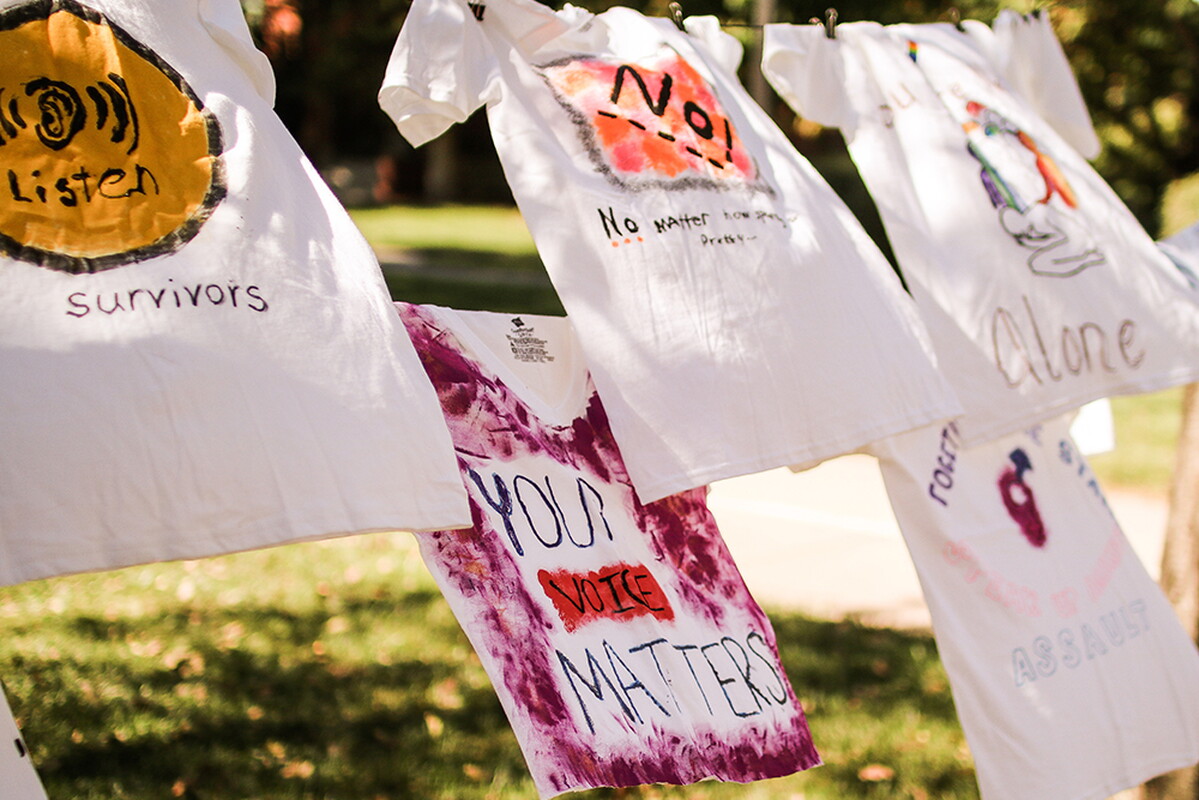
Students, faculty and staff participating in the Clothesline Project decorated t-shirts for display to bring awareness to gender-based violence.