
What can education mean to someone who is incarcerated, and what might stand in their way?
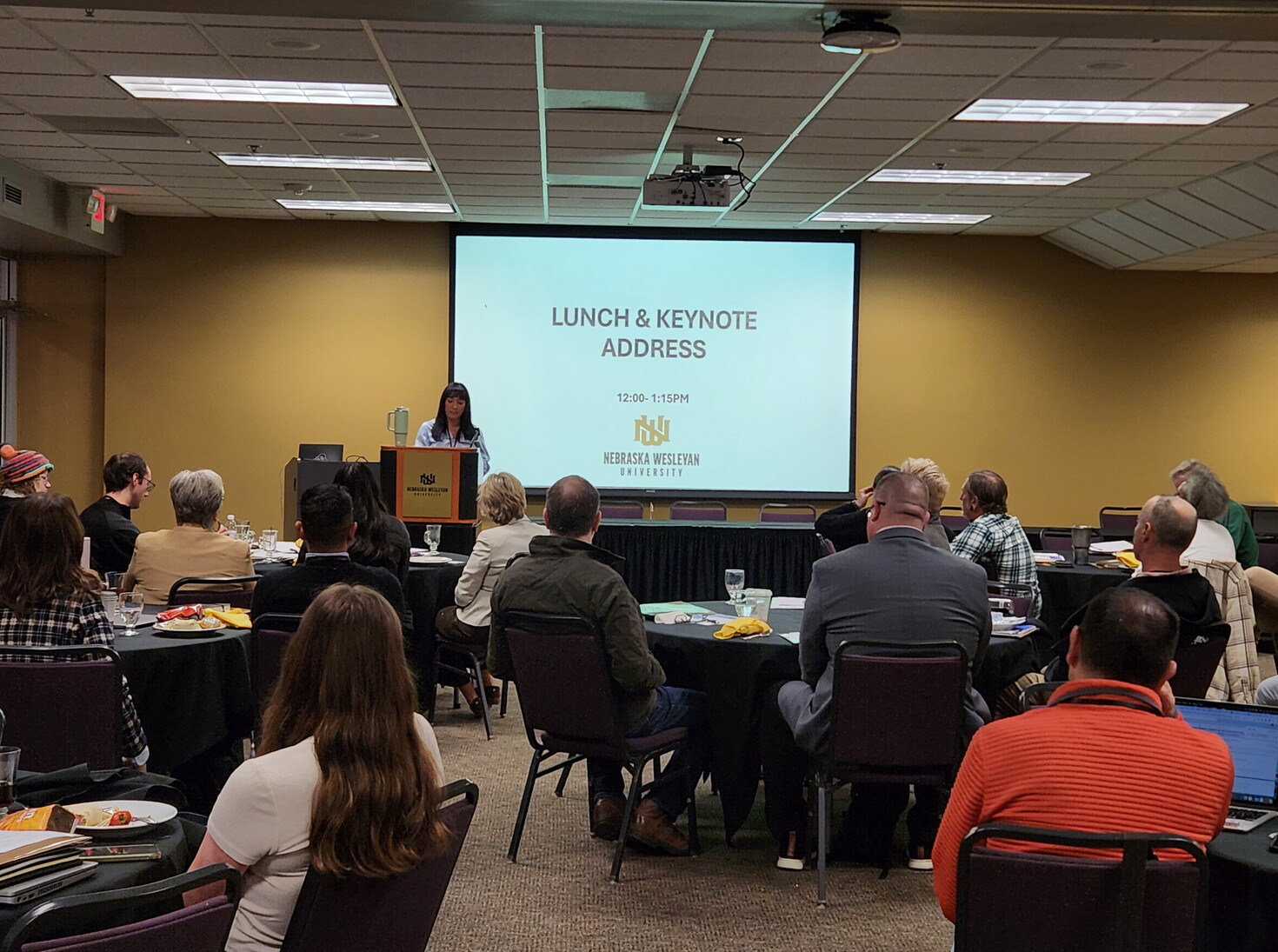
Four Nebraska Wesleyan students helped organize a one-day, statewide conference that drew more than 30 participants to discuss these questions and consider opportunities to expand educational networks and opportunities across the state.
The students, all enrolled in the Department of Sociology and Criminology’s Prison Outreach class, worked with Dr. Heba Khalil and Dr. Sue Wortmann to develop a conference dedicated to connecting those who are doing valuable work to support and enhance the education of incarcerated people while centering the voices of those who had lived experience in carceral settings.
Students Bella Longoria, Luis Garcia, Madi Hendrix-Jones, and Maria Ghanim began their work in early fall. They helped plan the conference by mapping key actors in educational programming, developing an agenda, and assisting with conference set up. They also identified and invited panel members and key speakers, and registered, introduced, and facilitated sessions.
Their efforts, combined with faculty input and key organizational contributions from staff assistant Cathy Earhart, yielded the attendance of critical stakeholders: the Nebraska Department of Corrections, Lancaster County Department of Corrections, and the Nebraska Consortium for Postsecondary Education in Prison.
The conference also drew participants from non-profit and community organizations: RISE, BraveBe, Child Advocacy Center, Center for People, Bridges to Hope, Nebraska Children and Families Foundation, Mental Health Association of Nebraska, ACLU Nebraska, and Omaha Home for Boys. Key university actors included Southeast Community College’s UPWARD program, which offers for-credit courses in four Nebraska carceral facilities.
Keynote speaker Tessa Domingus, Youth and Family Program Director at RISE, highlighted the impact of education in her own life. Domingus specifically credited WRAP (Wellness Recovery Action Plan) educational sessions in prison as helping her redirect her life, commitment, and reentry success.
In addition, panelists shared how education and books (from fantasy to law to Ulysees) helped them to survive and thrive in their years behind walls and into re-entry. Panelist James Perry, an NWU faculty member who, with NWU students as co-facilitators, has offered educational programming behind bars for more than 15 years, also spoke to the need for education and the changes he and his NWU students had seen in several students who were incarcerated, including the ability to speak, read, and think.
Conference attendees discussed continuing barriers to providing such an education: from larger cultural shifts needed to see the importance of second chances and education as a right of citizens to issues of access—including access to GED classes, internet access and technological training.
In addition, participants repeatedly emphasized the need to connect formal education with practical life skills, employment, housing, transportation, mental health support, family reunification, and continuity of education after release.
Participants expressed that one of the conference’s goals, “to connect educators doing valuable work to support incarcerated people”, was a priority for them. They underscored the idea that, while many organizations and individuals are doing important work across Nebraska it is important to establish better coordination, communication, resource sharing, and connections between universities, nonprofits, correctional institutions, government agencies, employers, and community organizations.
“Teaching Beyond Walls” was made possible through generous grants from the Wolf Fund and Alpha Kappa Delta (AKD) to the Sociology and Criminology Department.